
Hopefully this doesn’t come across as me having a go at procurement teams. I genuinely like procurement people. I love them when we win tenders. But the procurement process in general typically rewards the wrong behaviour.
When you optimise for lowest cost per deliverable, you're essentially asking agencies to compete on how efficiently they can produce outputs, not how effectively they can drive outcomes. It’s a beauty contest, not a process focused on delivering commercial success.
Why your procurement process rewards the wrong behaviour
The standard procurement framework for a digital project reads something like this: scope definition, capability assessment, cost comparison. This model assumes that all agencies with similar technical skills will deliver similar business results. This assumption isn’t just wrong; it's expensive. BCG (2024) found that only 35% of digital transformation projects reach their stated goals. The other 65% aren't failing because of poor project management or technical incompetence. They're failing because the selection criteria never measured the partner's ability to connect digital activity to business outcomes.
Consider the typical RFP/procurement evaluation matrix: technical capability (25%), price (30%), delivery track record (20%), team experience (15%), cultural fit (10%). Notice what's missing? Commercial acumen. Business outcome ownership. The ability to diagnose what drives revenue in your specific context. These capabilities don't appear on most scorecards because they're harder to measure than hourly rates and case study portfolios.
Australian businesses waste an estimated $5.4 billion annually on failed IT projects - yet the volume of investment is accelerating, not slowing. Only 32% of Australian digital projects are delivered on time, down from 42% in 2020, and just 50% deliver in line with business goals (MinterEllison CIO Sentiment Study, 2024). Globally, only 48% of digital initiatives meet or exceed their business outcome targets (Gartner, 3,100+ CIOs surveyed) - meaning most organisations are running multiple projects per year and losing value on roughly half of them with every procurement cycle.

The 3 critical questions you should be asking
The solution isn't better project management or clearer briefs. It's basically asking three questions that reveal whether a potential partner thinks in outputs or outcomes. These questions cut through the polished presentations and expose the fundamental difference between digital agencies that build things and agencies that drive results.
Most procurement questions focus on what agencies have done. These three questions focus on how they think. The answers reveal whether you're dealing with an order-taker or a business partner, whether they understand your commercial context or just your technical requirements.
Question 1: What does success look like?
The question: "What would you need to see six months after launch to consider this project successful?"
This question separates agencies that think in deliverables from those that think in outcomes. The answer reveals whether they understand that launch is the beginning of value creation, not the end of it.
What output-focused agencies say: "The platform would be live, stable and meeting all the functional requirements we've outlined. Users would be adopting the key features and we'd have resolved any post-launch issues. The project would be considered complete and handed over to your team for ongoing management."
What outcome-focused agencies say: "Six months post-launch, we'd want to see the platform driving measurable improvement in your key business metrics. Whether that's conversion rate, customer acquisition cost or operational efficiency. We'd want evidence that the platform is learning and improving, with data showing which features are driving the most value and where the next opportunities sit. Success means the platform is paying for itself and pointing toward its next evolution."
The difference is huge. Output-focused partners see their job as complete when they deliver what was specified. Outcome-focused partners see delivery as the start of a performance partnership. They think in terms of ongoing, compounding value, not completed tasks.
Watch for partners who ask about your measurement infrastructure before they ask about your technical requirements. The best partners want to understand how you'll know if the project worked before they start building anything. They're already thinking about the commercial story you'll need to tell the board in twelve months.
Question 2: How they validate before they build
The question: "Walk me through how you'd validate our core assumptions before we build anything."
This question exposes whether a partner has the intellectual courage to challenge your brief or the commercial discipline to reduce project risk before committing significant budget. Most agencies accept scope as given. The best agencies interrogate it.
What scope-accepting agencies say: "We'd conduct user research to validate the proposed features and ensure the user experience meets expectations. We'd also do technical discovery to confirm the platform requirements and integration points. This would inform our detailed project plan and help us refine the delivery timeline."
What assumption-challenging agencies say: "Before we build anything, we'd want to test the fundamental premise that this platform will solve the business problem you've identified. That might mean prototyping the core user journey with your actual customers or running small experiments to validate demand for the key features. We'd also want to understand what's driving the current performance gap. Is it really a platform problem or are there other factors we should address first?"
The second answer reveals a partner who understands that the biggest project risk isn't technical complexity or delivery timeline. It's building the wrong thing efficiently. They're willing to slow down the start to accelerate the outcome.
Partners who validate assumptions are also partners who take commercial responsibility. They know that if the core hypothesis is wrong, perfect execution won't save the project. They'd rather spend two weeks proving the concept than six months building something that won't drive results.
Question 3: Where they see the real risks hiding
The question: "What's the biggest risk to this project's commercial success and how would you mitigate it?"
This question reveals whether a partner thinks like a technologist or like a business leader. Technical risks can delay projects. Commercial risks can kill them. The best partners know the difference.
What technically-focused agencies say: "The biggest risks are usually around integration complexity, data migration or third-party dependencies. We'd mitigate these through thorough technical discovery, staging environments and robust testing protocols. We'd also build in buffer time for any unexpected technical challenges."
What commercially-focused agencies say: "The biggest risk is usually adoption. Building something that works perfectly but doesn't get used or gets used but doesn't change behaviour in ways that drive business results. We'd mitigate this by involving end users throughout the build process, designing for behaviour change rather than just functionality and ensuring the success metrics are built into the platform from day one, not bolted on afterwards."
Commercial-focused partners think about the human layer, not just the technical layer. They understand that most digital projects fail not because the code doesn't work, but because the experience doesn't align with how people actually behave or what the business actually needs.
They also think about the measurement layer. They know that if you can't prove the platform is working, it doesn't matter whether it actually is. They build measurement into the architecture, not into the post-launch wishlist.
What the answers actually tell you about partnership potential
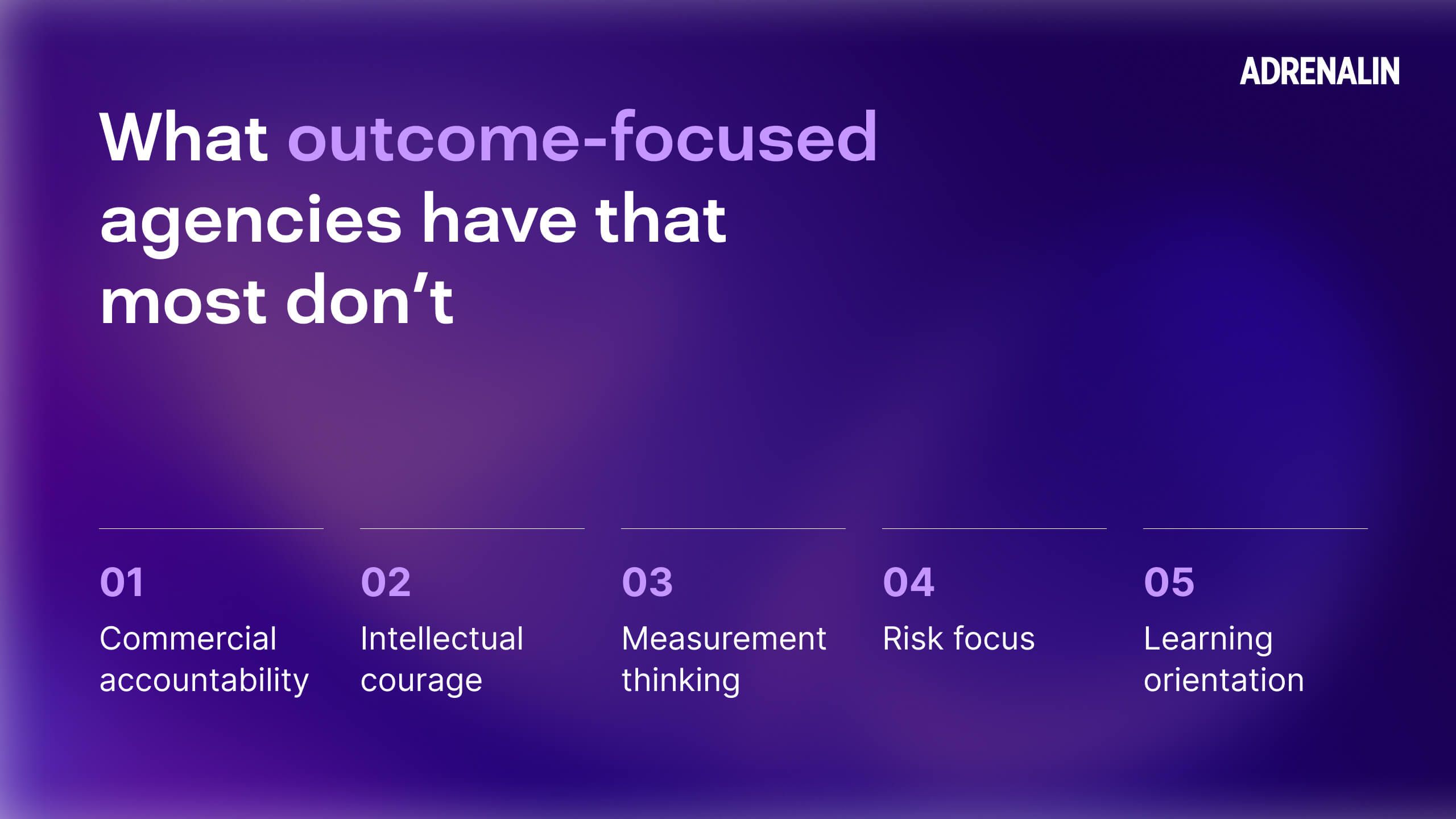
These three questions reveal five critical partnership capabilities that traditional procurement processes miss:
Commercial accountability: Partners who think in outcomes take responsibility for business results, not just delivery milestones. They understand that their reputation depends on your success, not just your satisfaction.
Intellectual courage: The best partners will challenge your assumptions, push back on your brief and suggest alternatives you hadn't considered. They're more interested in being right than being agreeable.
Measurement sophistication: Outcome-focused partners understand that what gets measured gets optimised. They think about analytics architecture, not just application architecture.
Risk calibration: They know the difference between risks that delay projects and risks that kill value. They focus their mitigation efforts on the things that matter to your business, not just your timeline.
Learning orientation: They see launch as the beginning of optimisation, not the end of engagement. They're building platforms that get smarter, not just platforms that work.
The organisations that consistently get better commercial outcomes from their digital investments aren't the ones with bigger budgets or clearer strategies. They're the ones who've learned to select partner digital agencies based on how they think, not just what they've built.

Learn from us
Join thousands of other Product Design experts who depend on Adrenalin for insights