
As of this month, October 2026, Australians have limited options to pay inside AI platforms like ChatGPT. In June, Google announced that Australians would be able to buy from Adore Beauty, Bunnings, Kogan, Petbarn and THE ICONIC without leaving AI Mode or the Gemini app. Google’s checkout rollout in Australia remains limited. In the US, you can already pay inside AI Mode and the Gemini app at select retailers. Even in the US it’s still limited: OpenAI moved away from checkout inside ChatGPT in March and now sends shoppers to the retailer’s own website to pay.
The reality today, though, is that most Australian shoppers say they’d rather press buy themselves on the retailer’s own website or mobile app. That’ll probably change at some point, but I don’t think it’ll be any time soon. The AI shopping that’s working in Australia is happening inside retailers’ own apps and websites. Woolworths, Bunnings and Kmart have built AI shopping assistants into their apps and websites, where you ask for what you need in your own words and the assistant finds the products and, in some cases, fills your basket.
The US is ahead of Australia on buying inside AI platforms
Here’s what a shopper can do in ChatGPT, Google’s Gemini app, Google’s AI Mode (the AI search tab in Google), Google Maps and Claude, in Australia and in the US, as of October 2026.
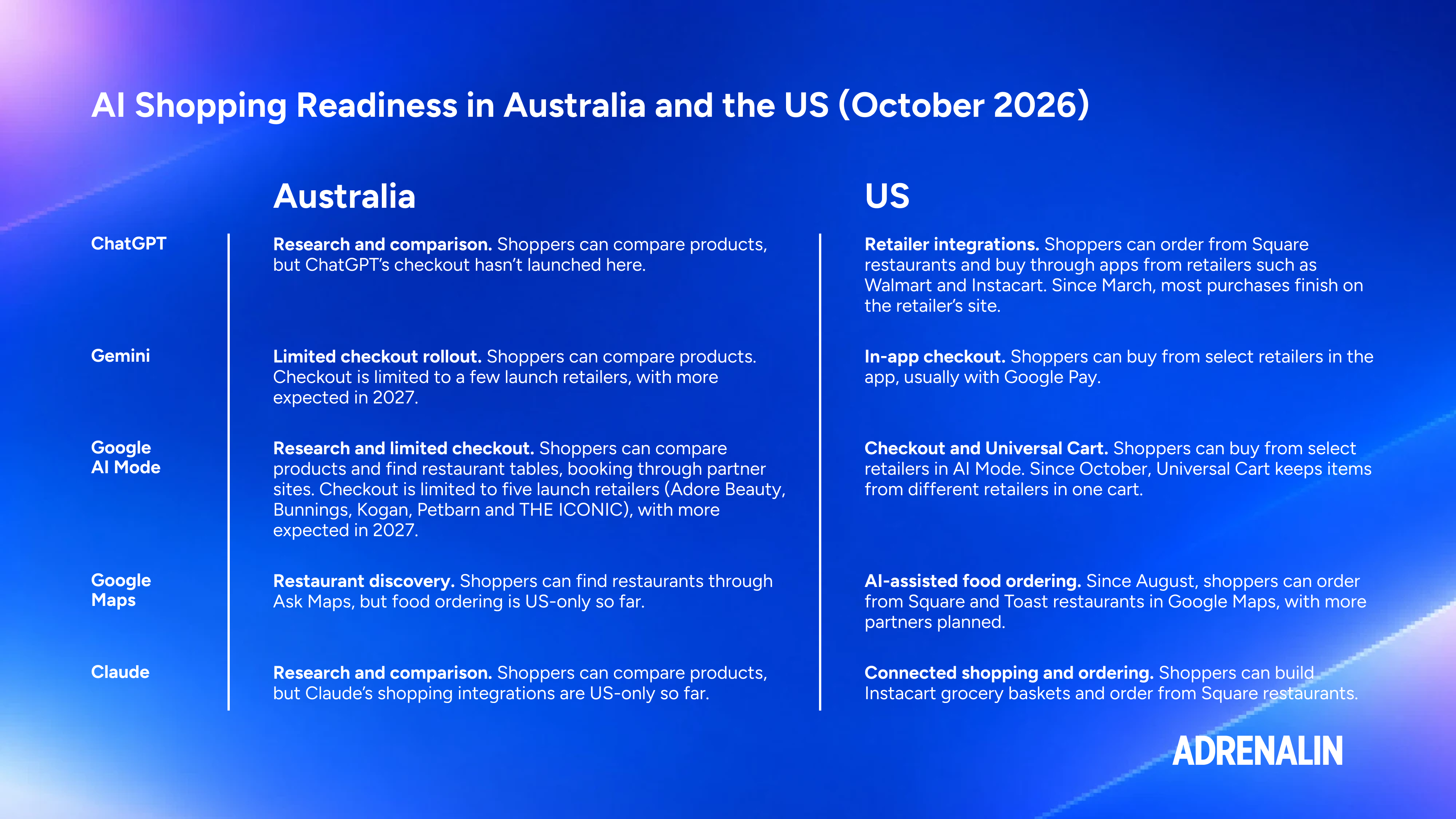
In the US, retailers sell inside AI platforms mainly through checkouts and listings built by the platforms they already use:
Google’s checkout is available to selected US retailers that apply through Google (Google, 2026).
Shopify lists eligible stores on its platform in ChatGPT and AI Mode for shoppers in the US (Shopify, 2026).
Only a few very large retailers, like Walmart, have built their own way of selling inside an AI platform.
I think Google’s checkout will be one of the first ways Australian retailers get to sell inside an AI platform.
Australians research with AI but prefer to buy themselves
Australians are already using AI to work out what to buy. In a survey of 2,023 people, Telsyte found 12% of Australians use AI tools as their primary way of finding information online, up from 5% a year earlier (Telsyte, 2026). That’s more than double in a year. Deloitte found 45% of Australians use AI to compare products and services, and only 11% use it to complete or automate a purchase (Deloitte, Retail Report 2026).
Letting AI do the buying is a much harder sell:
Adyen’s survey of 2,012 Australians, run by YouGov, found 26% are comfortable with AI completing a purchase for them, and just 5% are fully comfortable with it buying on its own (Adyen, 2026).
Australia Post found only 16% of shoppers are advocates of agentic commerce (AI agents doing the buying for you), compared with 44% of businesses (Australia Post, 2026).
In a seven-country survey by Global Payments, Australians were the most cautious about using AI agents to shop, with only 40% open to it (Global Payments, 2026).
For retailers, I think the AI that helps people choose is worth building now, and the part where it takes the payment can wait until shoppers and the AI platforms are ready.
Big retailers are building their own AI assistants
Woolworths: Woolworths’ assistant Olive, rebuilt on Google’s Gemini, has been rolling out since July to everyone using the Woolworths app for pick-up or delivery (Woolworths Group, 2026). Olive plans meals and builds a basket, and the customer reviews and approves every item before checkout. Woolworths has also said, “At this stage, we have no plans to place items in baskets based on commercial arrangements” (SmartCompany, 2026).
Bunnings: Bunnings’ Buddy, also built on Gemini, adds items to your basket (including from a photo of your shopping list), and checkout stays on bunnings.com.au (Bunnings, 2026). Bunnings’ managing director told iTnews that Buddy is “more than doubling online conversion rates” for shoppers who use it (iTnews, 2026). The doubling is Bunnings’ own figure, which Google Cloud also reports in its case study, and it’s the only published result I’ve found from an Australian retailer’s AI assistant so far.
Kmart and Officeworks: Kmart (Joy) and Officeworks (Ollie) have launched their own assistants (Wesfarmers, 2026; Officeworks, 2026).
Wesfarmers: Wesfarmers (which owns Bunnings, Kmart and Officeworks) is also piloting an assistant that works across its brands through OnePass, its shared membership program (Google Cloud, 2026).
I think the retailers have started in the right place, inside their own apps and websites, where they already run the checkout, the customer account and loyalty, and the product information the AI reads, which means the AI shopping assistant uses the same prices and stock as the website.

Being named in AI answers matters
Being recommended when shoppers ask ChatGPT or Google’s AI Mode what to buy is worth working on now, even though AI platforms still send only a small share of visits to websites. SE Ranking tracked 101,574 websites from January 2025 to April 2026 and found Google search still sends about 134 times more visitors than AI platforms (SE Ranking, 2026). At the start of 2025, the gap was about 300 times. SE Ranking’s data is global, and I haven’t seen the same figures published for Australia.
The visits AI does send convert a little better than search, though. Across 63 websites, The SEO Works found visits from AI platforms converted at 7.18%, against 6.08% for visits from normal search results, though AI traffic converted worse on 23 of those sites (The SEO Works, 2026).
Counting visits understates how much shoppers rely on AI, because many of them get their answer without a click. Telsyte found half of Australians would often rely on an AI summary in search results without clicking through to a website (Telsyte, 2026). So being named in that AI summary can put your products on a shopper’s shortlist before anyone visits your site. Google Analytics also counts clicks from Google’s AI answers as ordinary search, so some of the visits AI sends you are already in your normal search numbers without being labelled (Google, 2026).
SEO (search engine optimisation) is the work of ranking well in Google’s normal search results. The newer work of getting your products named in the answers AI platforms write goes by GEO (generative engine optimisation) or AEO (answer engine optimisation). You’ll see the two names used for the same thing.
SEO and GEO overlap, but ranking well in Google isn’t enough on its own, because AI answers also draw on pages that don’t rank well:
seoClarity found 94% of US searches showing an AI Overview (the AI summary at the top of Google’s results) linked to at least one page from the top 20 results (seoClarity, 2025).
But Ahrefs found only 37.9% of the pages AI Overviews linked to ranked in Google’s top 10, and 31% ranked outside the top 100 (Ahrefs, 2026). Its July 2025 study put the top-10 share at about 76%, though Ahrefs has since changed its method.
Reddit is also one of the most cited websites in ChatGPT’s search answers and Google’s AI Mode (Semrush, 2025), so what people say about your products away from your own site counts too.
All of these studies are by firms that sell search services, and none of them is Australian.
The first thing I’d do is ask ChatGPT and Google’s AI Mode the questions your customers ask, and see whether your products come up and where the answer sends people.
Build AI assistants into your own website and app
While Google and OpenAI sort out checkout in Australia, the place to build is your own website and app, and there are some pretty clear advantages to starting there:
You own the platform. The assistant looks and sounds like your brand, and you decide what it can and can’t do.
You own the customer. Shoppers in your app are usually signed in, so the assistant can use their account, past orders and loyalty rewards, and that data stays with you.
You own the sale. The payment, the returns and the ongoing relationship stay with you, whereas a marketplace would take the payment and keep the customer’s details.
Agentic commerce on your own website or app also fits how Australians want to shop. In a survey of 1,000 Australian online shoppers, Commerce and PayPal found 63% are interested in trying an AI shopping tool, and only 4% want AI involved when they pay (Commerce and PayPal, 2026). An assistant in your own app works that way: it helps the customer find and choose, builds the basket and leaves the payment to your normal checkout. You can also start today instead of waiting on Google’s or OpenAI’s dates, and you’ll see what your customers ask for in their own words.
You’re also building on the systems you already run: your product information, prices, stock, customer accounts, loyalty, payments and so on. The AI works out what the customer wants, and those systems set the price and apply the reward, the same way they do for every other order.
Be ready when AI platforms open checkout
As more Australians can pay inside AI platforms, the retailers who already have AI in their own apps and their product information in order will be the ones ready to sell through them.
If you want to see what ChatGPT and Google’s AI Mode say about your products right now, we’ll run that check for you.

Learn from us
Join thousands of other Product Design experts who depend on Adrenalin for insights